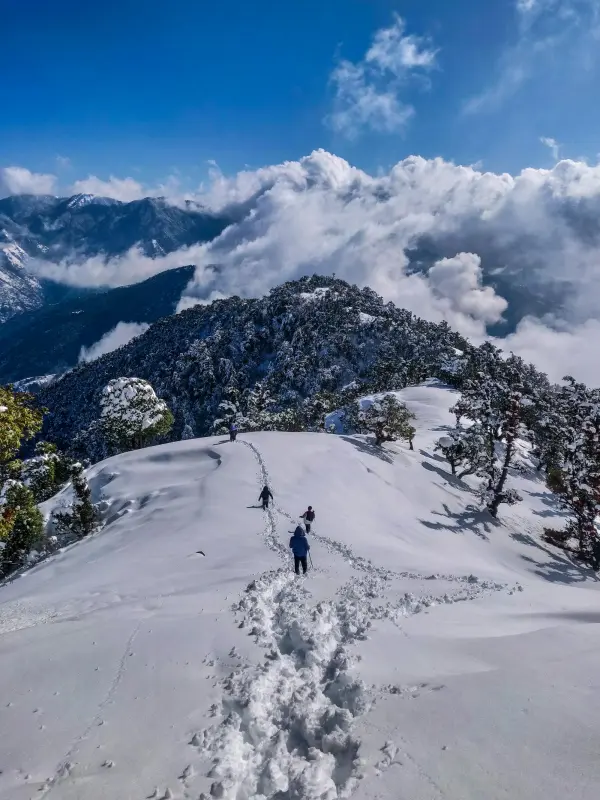
The full Char Dham circuit from Haridwar in the traditional order, with the Yamunotri and Kedarnath treks each given a day of their own
The four shrines are visited in a fixed order — Yamunotri, then Gangotri, then Kedarnath, then Badrinath — because that is the way the road runs and the way the yatra has always been done. From Haridwar you climb west to Barkot for Yamunotri, cross to Uttarkashi for Gangotri, take the long road east to Guptkashi for Kedarnath, and finish over the Joshimath side at Badrinath. Eleven days is what the circuit honestly needs if the two treks are not to be rushed.
Everything on the ground is arranged: a private vehicle with a driver who works these roads, hotels at each halt, breakfast and dinner every day, and help with the compulsory yatra registration. Two days involve real walking — about 6 km each way to Yamunotri from Janki Chatti, and 16 km each way to Kedarnath from Gaurikund. Ponies, palkis and the Kedarnath helicopter shuttle are available on both routes and can be arranged for you at extra cost as applicable.
The essentials
Trip information
Package code
EH11CD001
Pickup
Haridwar Junction Railway Station
Drop
Haridwar Junction Railway Station
Night count
10 Nights, 11 Days
Travellers
6 pax
Vehicle
Toyota Innova Crysta (AC)
At a glance
Itinerary highlights
Day 1Arrive in Haridwar and register for the yatra
Day 2Haridwar to Barkot by way of Mussoorie
Day 3Yamunotri — the trek from Janki Chatti
Day 4Barkot to Uttarkashi
Day 5Gangotri and back to Uttarkashi
Day 6The long crossing to Guptkashi
Day 7Kedarnath — the 16 km climb from Gaurikund
Day 8Down from Kedarnath to Guptkashi
Day 9Guptkashi to Badrinath by way of Joshimath
Day 10Mana village, then down to Rudraprayag
Day 11Rudraprayag to Haridwar, and the journey home
Your route, day by day
Day-by-day itinerary
Haridwar
The gateway town where the Ganga leaves the hills, and the traditional starting point of the Char Dham circuit.
Day 1
Arrive in Haridwar and register for the yatra
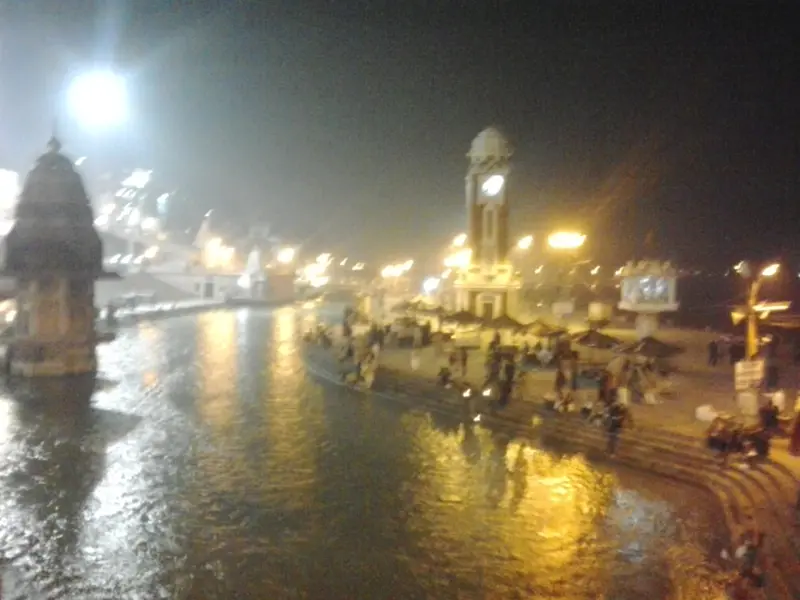
You are met at Haridwar Junction and taken to the hotel. The main business of the day is the yatra registration — we help you complete it and get the biometric verification done, so keep the photo ID you used in the application to hand. In the evening you go down to Har Ki Pauri for the aarti. Repack tonight if you can: one small bag for the Kedarnath night and the rest left in the car.
Starts from Haridwar Junction Railway Station, ends at Hotel Haridwar Grand, covering around 6 km in an estimated 25m.
Sightseeing
Har Ki PauriGhat open all day, aarti at sunsetAllow 90 min
The principal ghat of Haridwar, held to bear a footprint of Vishnu and the site of the Kumbh Mela bathing. At dusk tiered lamps are lit and swung over the water while bells sound from both banks, and leaf boats with flowers and a flame are set on the current.
Take a place on the steps before dusk
Float a lamp on the river
Hold the chains if you bathe — the current is strong
Barkot
A small town on the Yamuna at about 1,220 m, the road base for the Yamunotri trek.
Day 2
Haridwar to Barkot by way of Mussoorie
An early start west through Dehradun and up over Mussoorie, then down the far side of the ridge into the Yamuna valley. The road crosses Kempty and follows the river up to Barkot, where you arrive in the late afternoon. It is a long drive but a scenic one, and there is nothing else on the schedule. Dinner is early and so is the alarm — tomorrow is the Yamunotri trek.
Starts from Hotel Haridwar Grand, ends at Yamuna Valley Resort Barkot, covering around 180 km in an estimated 7h 00m.
Sightseeing
Kempty FallsOpen 8 AM – 6 PMAllow 45 min
A five-stage waterfall on the far side of Mussoorie, right on the Barkot road. A short stop here breaks the drive at about the halfway point, and there are stalls and tea above the terrace.
Look down on the falls from the road terrace
Stop for tea
Stretch your legs before the second half of the drive
Yamuna valley roadDaylight hoursAllow 120 min
The stretch from Nainbagh up to Barkot runs beside the young Yamuna the whole way, through terraced fields and pine. It is the first proper sight of Garhwal on the trip and worth a couple of stops.
Stop at a riverside viewpoint
See the terraced hillside farms
Photograph the Yamuna near Barkot
Yamunotri
The first of the four shrines, at about 3,293 m at the head of the Yamuna valley, reached only on foot.
Day 3
Yamunotri — the trek from Janki Chatti
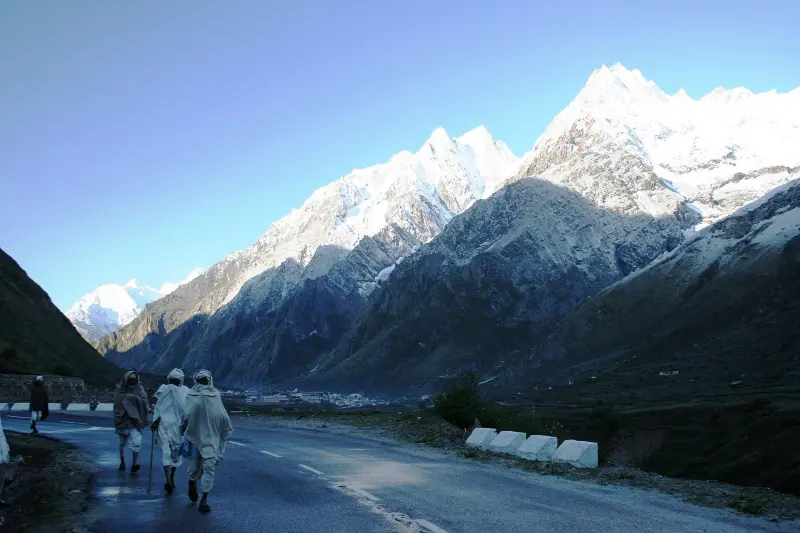
You leave before first light and drive about 45 km up to Janki Chatti, where the road ends. From there it is roughly 6 km on foot to the temple, climbing steadily on a paved path — allow three to four hours up and rather less coming down. Ponies, palkis and porters wait at the trailhead and can be taken for all or part of the way, charged extra as applicable. After darshan you walk back down to Janki Chatti and drive to Barkot for the night.
Based at Yamuna Valley Resort Barkot, covering around 90 km road + 12 km trek in an estimated 11h 00m.
Sightseeing
Yamunotri TempleOpen 6 AM – 8 PM in seasonAllow 60 min
The source shrine of the Yamuna, dedicated to the goddess and standing below the Bandarpunch massif. The present temple has been rebuilt more than once after avalanche damage. The actual glacier source at Champasar is higher up and not part of the pilgrim route.
Take darshan at the shrine
See the Divya Shila rock beside the temple
Rest at the temple courtyard before the descent
Surya KundOpen with the templeAllow 30 min
A hot spring beside the temple whose water runs close to boiling. Pilgrims lower rice and potatoes tied in muslin into it and carry the cooked food away as prasad.
Cook rice prasad in the spring
Bathe at the Jamunabai Kund
Watch the steam against the cold air
Janki ChattiOpen all dayAllow 45 min
The last road head, at about 2,650 m, where the trek begins and ends. It has its own hot springs, a line of tea shops and the pony and palki stand.
Eat before starting the climb
Arrange a pony or palki if needed
Soak tired feet in the hot spring afterwards
Uttarkashi
A town on the Bhagirathi at about 1,160 m, the district headquarters and the base for Gangotri.
Day 4
Barkot to Uttarkashi
A shorter and easier day after yesterday. The road climbs out of the Yamuna valley over the Radi top and drops into the Bhagirathi valley at Dharasu, then follows the river up to Uttarkashi. You should arrive by early afternoon, which leaves time for the Vishwanath temple in the old town and a walk by the river.
Starts from Yamuna Valley Resort Barkot, ends at Bhagirathi Riverside Uttarkashi, covering around 95 km in an estimated 4h 00m.
Sightseeing
Kashi Vishwanath Temple, UttarkashiOpen 6 AM – 7 PMAllow 45 min
The temple the town is named for — Uttarkashi means the Kashi of the north. It holds a large stone lingam and, in the courtyard opposite, an old brass trident that is one of the oldest objects in the valley.
Take darshan of the lingam
See the Shakti trident opposite
Walk through the old bazaar
Bhagirathi riverfrontOpen all dayAllow 45 min
The ghats and the footbridge below the town, where the Bhagirathi runs wide and grey with glacier silt. A quiet evening walk and a good place to sit before the Gangotri run.
Walk across the footbridge
Sit at the ghats at dusk
Look up the valley towards Gangotri
Nehru Institute of MountaineeringOpen 10 AM – 5 PM, closed SundaysAllow 45 min
India's best-known climbing school, a few kilometres out of town, with a small museum of Himalayan expedition equipment and photographs. Worth a short stop if the timing works.
See the expedition museum
Look at the training wall
Read the Everest expedition displays
Gangotri
The second shrine, at about 3,100 m on the Bhagirathi, and the only one of the four the road reaches all the way.
Day 5
Gangotri and back to Uttarkashi
An early start for the drive up the Bhagirathi gorge — about 100 km, but slow going, with the road cut into the cliff above the river for much of the way. You stop at Gangnani for the hot spring if there is time, cross the Harsil valley with its apple orchards and deodar, and reach Gangotri by late morning. There is no trek here: the temple is a few minutes from the parking. You return the same way and are back in Uttarkashi for dinner.
Based at Bhagirathi Riverside Uttarkashi, covering around 200 km in an estimated 10h 00m.
Sightseeing
Gangotri TempleOpen 6:15 AM – 9:30 PM in seasonAllow 90 min
An eighteenth-century white granite temple beside the Bhagirathi, built by a Gorkha commander and rebuilt since. This is where Ganga is said to have come to earth in Shiva's hair. The glacier snout at Gaumukh, the physical source, lies 18 km further up and is a separate trek.
Take darshan at the temple
See the submerged Bhagirath Shila offshore
Fill a vessel with water from the river
Bhagirath Shila & Surya KundOpen all dayAllow 30 min
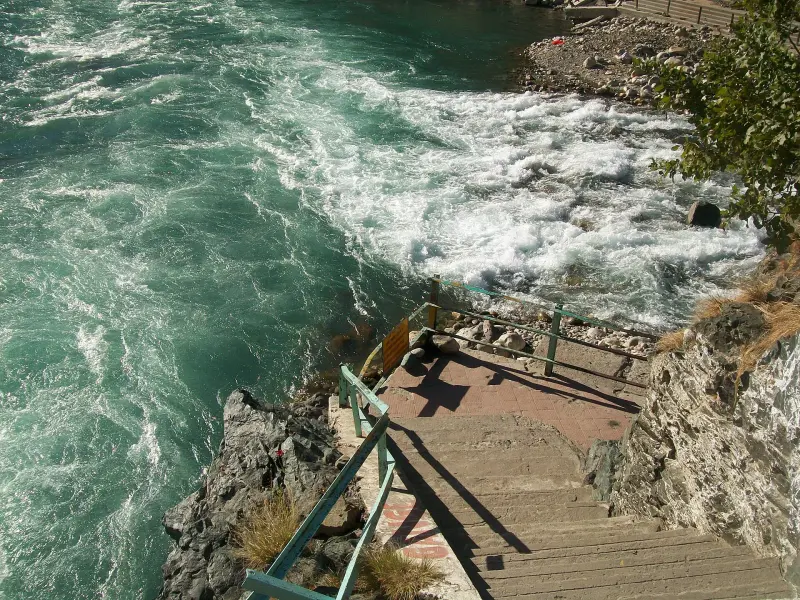
Just below the temple the river drops through a narrow rock gorge into a pool called Surya Kund. The slab of rock beside it is where King Bhagirath is said to have sat in penance until the Ganga descended.
Walk down to the gorge viewpoint
See the rock and the falls
Listen to the river through the gorge
Harsil & GangnaniDaylight hoursAllow 60 min
Two stops on the drive up: Gangnani, with a hot sulphur spring where pilgrims bathe before going higher, and Harsil, an army-and-orchard village in a wide deodar valley about 25 km short of Gangotri.
Bathe at the Gangnani spring
Stop for tea at Harsil
Photograph the Bhagirathi peaks from the valley
Guptkashi
A ridge town above the Mandakini at about 1,320 m, and the road base for Kedarnath.
Day 6
The long crossing to Guptkashi
The longest driving day of the yatra, moving from the Bhagirathi valley to the Mandakini. The road runs down to Tehri, along the reservoir, then through Srinagar and Rudraprayag before turning north up the Mandakini to Guptkashi. Two of the five sacred confluences are passed on the way. Reach in the evening, sort out a small bag for tomorrow and leave the rest of the luggage at the hotel.
Starts from Bhagirathi Riverside Uttarkashi, ends at Kedar View Guptkashi, covering around 220 km in an estimated 8h 30m.
Sightseeing
Tehri LakeDaylight hoursAllow 30 min
The reservoir behind the Tehri dam, one of the tallest dams in the world, which flooded the old town of Tehri in the 2000s. The road runs along its edge for a good stretch and there are viewpoints on the way.
Stop at a lake viewpoint
See the dam wall from the road
Photograph the flooded valley
DevprayagOpen all dayAllow 45 min
The confluence where the Alaknanda meets the Bhagirathi and the river becomes the Ganga. The two currents arrive in visibly different colours and take a moment to merge below the steps.
Walk down to the sangam steps
See the two rivers meet
Visit the Raghunath temple above
Rudraprayag sangamOpen all dayAllow 30 min
Where the Mandakini, coming down from Kedarnath, joins the Alaknanda. The road forks here — one arm to Kedarnath, the other to Badrinath — which makes it the hinge of the whole eastern half of the yatra.
See the confluence from the bridge
Stop at the Rudranath temple
Take tea before the last climb
Kedarnath
The third shrine, at about 3,583 m below the Kedarnath peak, and the hardest of the four to reach.
Day 7
Kedarnath — the 16 km climb from Gaurikund
The big day. You drive early to Sonprayag, where private vehicles must stop, and take the shared shuttle the last 5 km up to Gaurikund. From Gaurikund the trek is 16 km, gaining well over 1,000 m, on a rebuilt path through Jungle Chatti, Bhimbali and Linchauli. Most people take seven to nine hours. Ponies, palkis and porters work the route, and the helicopter shuttle from Phata or Sersi is an alternative for those who cannot walk it — either can be arranged at extra cost as applicable. Evening darshan and aarti, then a cold night at the shrine.
Starts from Kedar View Guptkashi, ends at Kedarnath Yatri Niwas, covering around 30 km road + 16 km trek in an estimated 9h 00m.
Sightseeing
Kedarnath TempleOpen 5 AM – 9 PM in season, with a break in the afternoonAllow 120 min
A stone temple of massive interlocking blocks, one of the twelve Jyotirlingas and the highest of them. It survived the 2013 floods when much of the settlement around it did not, protected by a boulder that split the flow above the walls. That rock still stands behind the temple.
Take evening darshan
Attend the aarti
See the boulder behind the temple
The Gaurikund trekGates open around 4 AMAllow 7-9 hours
A paved and railed path rebuilt after 2013, following the Mandakini through Jungle Chatti, Bhimbali and Linchauli. There are tea stalls, medical posts and toilets at intervals. The last two kilometres open out and the temple comes into sight against the peak.
Start at first light
Drink often and walk at a steady pace
Rest at the medical posts if you feel breathless
Bhairavnath TempleDaylight hoursAllow 45 min
A small shrine on the ridge about half a kilometre above and behind the main temple, dedicated to the guardian of Kedarnath. The climb is short but steep at that altitude, and it gives the best view down over the whole valley.
Walk up the ridge path
Look down on the temple and the river
Go in the evening light if you have the energy
Guptkashi
Back at the road head on the Mandakini, with a hot shower and a proper bed.
Day 8
Down from Kedarnath to Guptkashi
Morning darshan and aarti at the temple, then breakfast and the walk back down. Descending takes around five hours and is easier on the lungs but harder on the knees — walking poles help. From Gaurikund the shuttle takes you to Sonprayag, where the car is waiting, and it is a short drive on to Guptkashi. The afternoon is for rest, with the Ardh Narishwar temple in the town if you feel up to it.
Starts from Kedarnath Yatri Niwas, ends at Kedar View Guptkashi, covering around 16 km trek + 30 km road in an estimated 8h 00m.
Sightseeing
Kedarnath morning aartiFrom about 5 AMAllow 60 min
The first aarti of the day, before the crowds come up from Gaurikund. Cold, quiet and the best time to be inside the temple.
Attend the early aarti
Take a last circuit of the temple
Photograph the peak at sunrise
Ardh Narishwar Temple, GuptkashiOpen 6 AM – 7 PMAllow 45 min
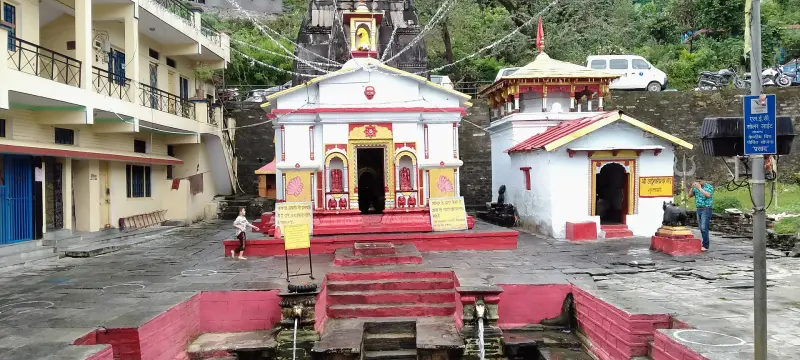
A temple in Guptkashi town showing Shiva and Parvati in a single half-and-half form. In the courtyard, water from two spouts shaped as a cow's mouth and an elephant's head runs into the Manikarnik Kund. The name Guptkashi comes from the story of Shiva hiding here from the Pandavas.
See the half-and-half image
Look at the Manikarnik Kund spouts
Sit in the courtyard with the valley view
Badrinath
The last of the four shrines, at about 3,133 m on the Alaknanda between the Nar and Narayan peaks.
Day 9
Guptkashi to Badrinath by way of Joshimath
You drop back to Rudraprayag, take the other arm of the fork and follow the Alaknanda up through Karnaprayag, Nandaprayag and Chamoli to Joshimath. Above Joshimath the road narrows through the gorge past Vishnuprayag and Hanuman Chatti, and traffic may be held at gates on that stretch. Badrinath appears suddenly at the top of the valley. There is no trek — the temple is minutes from the hotel — so if you arrive in good time there is evening darshan.
Starts from Kedar View Guptkashi, ends at Narayan Palace Badrinath, covering around 215 km in an estimated 8h 30m.
Sightseeing
Badrinath TempleOpen 4:30 AM – 1 PM and 4 PM – 9 PM in seasonAllow 120 min
A brightly painted temple above the Alaknanda, one of the Char Dham of India as well as of Uttarakhand. The black stone image of Badrinarayan is said to have been recovered from the river and installed by Adi Shankaracharya. The head priest is traditionally drawn from Kerala.
Take darshan of Badrinarayan
Bathe at the Tapt Kund hot spring below
See the temple lit at night
JoshimathDaylight hoursAllow 45 min
The town on the shoulder above Vishnuprayag where the Badrinath deity spends the winter, and the site of one of the four maths founded by Adi Shankaracharya. It is also the junction for Auli and the Valley of Flowers.
Visit the Narsingh temple
See the Kalpavriksha mulberry tree
Stop for lunch before the last climb
VishnuprayagDaylight hoursAllow 30 min
The confluence of the Dhauliganga and the Alaknanda, the first of the five prayags counting down from Badrinath, set in a tight gorge below the road.
View the confluence from the road
Photograph the gorge
Stop at the roadside shrine
Mana
The last village before the Tibet border, 3 km beyond Badrinath, at about 3,200 m.
Day 10
Mana village, then down to Rudraprayag
Early morning darshan at Badrinath, then a short drive up to Mana before the long descent begins. Mana is a Bhotia village of stone houses that empties out entirely for the winter, and the walk to the caves and the Saraswati bridge takes an hour or so. After that you drive back down the Alaknanda to Rudraprayag for the night, breaking the return so that the last day is short.
Starts from Narayan Palace Badrinath, ends at Sangam Retreat Rudraprayag, covering around 165 km in an estimated 6h 30m.
Sightseeing
Mana VillageOpen in season, daylight hoursAllow 90 min
The last inhabited village on this road, occupied only for the summer months. Vyas Gufa, where the Mahabharata is traditionally said to have been dictated, and Ganesh Gufa are a short walk up through the lanes, and the villagers weave and sell wool at stalls along the way.
Walk up to Vyas and Ganesh caves
See the Bhim Pul rock bridge over the Saraswati
Buy local wool from the village stalls
Tapt Kund & Mata Murti TempleOpen 5 AM – 7 PMAllow 45 min
The hot sulphur spring on the riverbank directly below Badrinath temple, where pilgrims bathe before darshan, and the Mata Murti shrine a few kilometres along the Alaknanda dedicated to Badrinarayan's mother.
Bathe at the Tapt Kund
Visit Mata Murti temple
See the Alaknanda from the footbridge
Karnaprayag & NandaprayagDaylight hoursAllow 45 min
Two more of the five confluences on the way down — the Pindar joining at Karnaprayag and the Nandakini at Nandaprayag. Both are easy roadside stops and break the descent.
See the Pindar meet the Alaknanda
Visit the Karna temple
Stop for tea at Nandaprayag
Rudraprayag
The confluence town where the Mandakini meets the Alaknanda, and the last halt of the yatra.
Day 11
Rudraprayag to Haridwar, and the journey home
Breakfast and an unhurried start. The road follows the Alaknanda down through Srinagar and Devprayag, then the Ganga through Rishikesh to Haridwar. You are dropped at Haridwar Junction, or at Jolly Grant Airport in Dehradun if you are flying — tell us which when you book and we will time the departure to suit. Allow buffer on the day: hill traffic is unpredictable.
Starts from Sangam Retreat Rudraprayag, ends at Haridwar Junction Railway Station, covering around 165 km in an estimated 5h 30m.
Railway station pick-up and drop at Haridwar
× 2
Barkot to Janki Chatti road transfer for Yamunotri
× 2
Uttarkashi to Gangotri road transfer
× 2
Guptkashi to Sonprayag transfer for Kedarnath
× 2
The fine print, clearly
What’s included
Inclusions
Ten nights of accommodation across Haridwar, Barkot, Uttarkashi, Guptkashi, Kedarnath, Badrinath and Rudraprayag.
Daily breakfast and dinner, vegetarian, at each halt.
The whole circuit by private vehicle with a driver experienced on Garhwal hill roads.
Assistance with the compulsory Uttarakhand Char Dham yatra registration.
Driver allowance, fuel, toll, green tax, permits and parking charges.
A local coordinator on call for the length of the yatra.
24×7 destination support for the whole trip.
Exclusions
Train or air fare to Haridwar or Dehradun and back.
Ponies, palki, porters and the Kedarnath helicopter shuttle, arranged on request and charged extra as applicable.
The shared shuttle between Sonprayag and Gaurikund, which private vehicles are not allowed to make.
Special darshan or VIP pass arrangements at any shrine.
Lunch, tea, bottled water and anything outside the fixed hotel menu.
Medical costs, evacuation, travel insurance and personal expenses.
GST, charged extra on the final bill as applicable.
Good to know
Policies
Payment policy
50% of the package cost is needed at the time of booking to confirm it.
The remaining 50% must be cleared at least 21 days before the yatra starts.
Peak yatra season (May, June and the weeks either side of the opening dates) needs full payment at booking.
The booking is confirmed only once the advance payment reaches us.
Payment by bank transfer or UPI.
Cancellation policy
0–15 days before check-in: 100% of the booking amount is charged.
16–30 days before check-in: 70% of the booking amount is charged.
31–45 days before check-in: 30% of the booking amount is charged.
A minimum cancellation charge of 10% applies in all cases.
No refund for unused nights, a shrine missed on health grounds or an early departure.
Peak yatra season (1 May – 30 June): no refund on cancellation.
Important information
The Char Dham season runs from roughly late April or early May to October or November. The shrines close for winter on dates fixed each year, and the deities move to their winter seats.
Uttarakhand yatra registration is compulsory for every traveller, with biometric or photometric verification done at Haridwar, Rishikesh or the other registration counters. Carry the original photo ID used in the application.
The Kedarnath trek is 16 km each way from Gaurikund with a climb of well over 1,000 m, and the shrine stands at about 3,583 m. It is a demanding walk and takes most of a day.
Yamunotri is a 6 km trek each way from Janki Chatti, steep in places. Ponies, palkis and porters are available on both routes at extra cost as applicable.
A basic medical check-up before travelling is sensible, particularly for anyone over 55 or with a heart, lung or blood-pressure condition. Carry your prescriptions and a doctor's note.
Weather, landslides and road closures can change the schedule at short notice. The itinerary may be reordered or a halt changed for safety; we tell you as soon as we know.
Carry warm layers, a waterproof, a torch and sturdy walking shoes. Nights are cold at every halt even in June, and mobile coverage is patchy above Guptkashi.
 Easy Holiday